
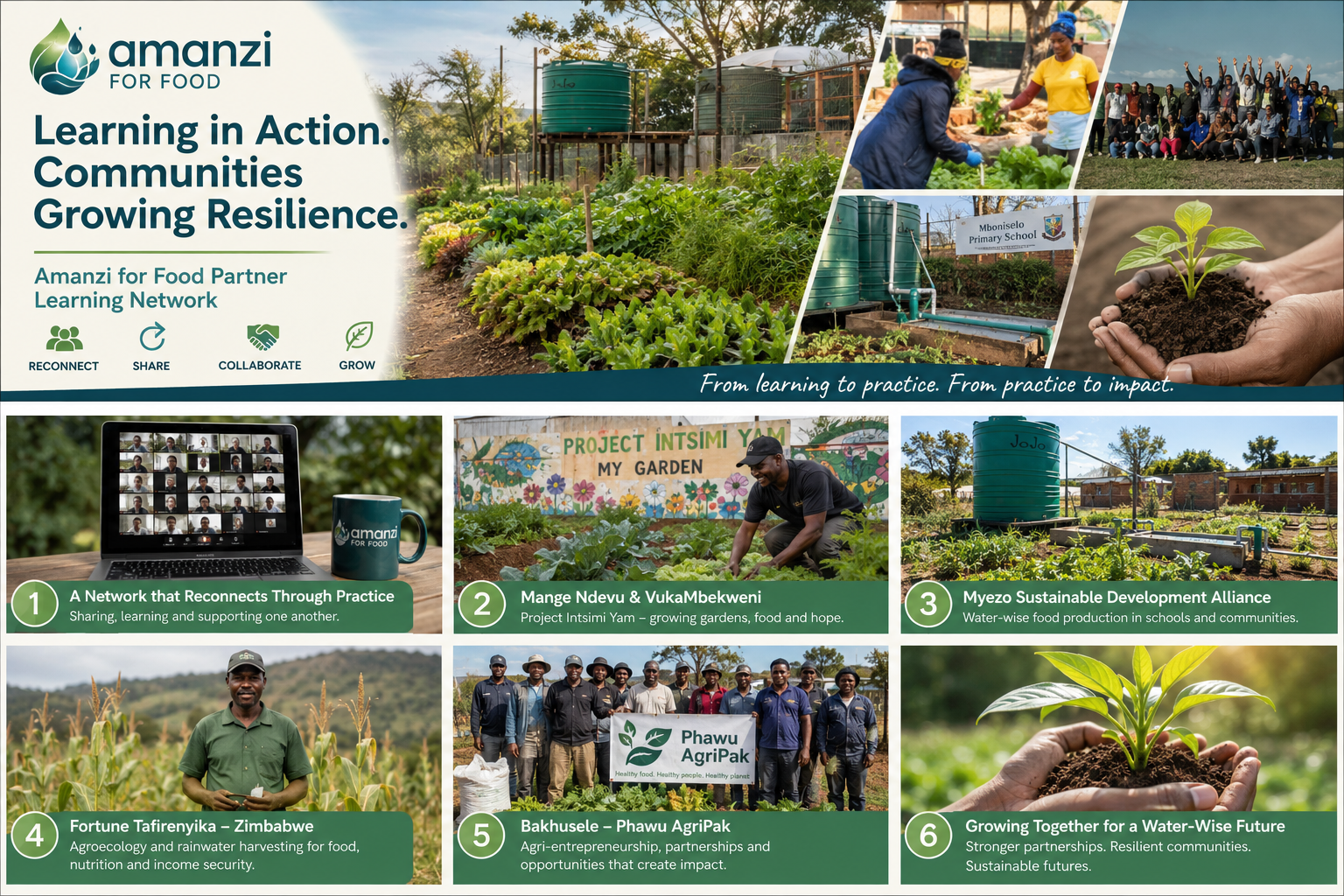
Across the Amanzi for Food Partner Learning Network, learning is increasingly becoming visible in practice — in household gardens, community food projects, water-wise farming, environmental restoration and new partnerships.
On 11 August 2026, members of the Amanzi for Food Partner Learning Network came together online to reconnect, share, collaborate and grow. The meeting created space for partners to share what they are currently doing, hear about new Amanzi for Food learning opportunities and micro-credentials, and explore possibilities for greater collaboration across the network.
The conversations highlighted something important: the Learning Network is not simply a space where information is shared. It is becoming a network through which knowledge is tested, adapted and put into practice in different communities and farming contexts.
Learning that grows beyond the course
One of the stories featured in our latest newsletter is that of Mange Ndevu and VukaMbekweni Community Empowerment Organisation in Mbekweni, Paarl.
Through Project Intsimi Yam – “My Garden”, Mange and his colleagues are working towards transforming under-used spaces, household backyards and areas affected by illegal dumping into productive nutritional gardens.
The project brings together agroecology, rainwater harvesting and conservation, environmental education, community participation and food security. VukaMbekweni’s longer-term vision is to work with households, schools, municipal spaces and community organisations to create greener, healthier and more productive neighbourhoods.
Most recently, Mange has also been working directly with elderly women, helping them establish and strengthen gardens in their own backyards. Some of the plants used in these gardens have come from his wider agricultural learning and networking activities.
This is a powerful example of what the Learning Network hopes to encourage: knowledge moving from learning platforms into practical community action.
Water-wise practice supporting communities
Members of the Myezo Sustainable Development Alliance have also been sharing practical examples of community-based food production and water-wise gardening.
Their activities have included supporting schools, community gardens and households, as well as improving irrigation systems so that harvested rainwater stored in JoJo tanks can be used more effectively for food production at places such as Mboniselo Primary School.
At the time of our August Learning Network meeting, Myezo was also preparing to share experiences of water-wise gardening, drawing directly on knowledge gained through Amanzi for Food courses and assignments.
These examples demonstrate how rainwater harvesting and conservation can become much more than a technical intervention. When connected to food gardens, schools and community organisations, water becomes part of a wider approach to resilience, learning and local food security.
Learning across borders
The Learning Network also connects practitioners beyond South Africa.
Fortune Tafirenyika, based in Zaka District in Masvingo Province, Zimbabwe, is applying agroecological approaches focused on rainwater harvesting and conservation for food, nutrition and income security at household level.
Fortune has shared his experiences of using in-field rainwater harvesting in maize production and has reported strong improvements in crop performance as soil moisture management has improved. His contributions bring an important regional perspective to the network and demonstrate how practitioners can learn from one another across very different farming environments.
Partnerships creating new opportunities
Another Learning Network partner, Bakhusele of Phawu AgriPak, continues to demonstrate how agricultural practice, entrepreneurship and institutional partnerships can come together.
Phawu AgriPak and its affiliated farmers and agribusinesses have been recognised as examples of work connecting healthy food production, environmental sustainability and pathways towards decent work and agri-entrepreneurship. Bakhusele has also taken on a leadership role in the Amathole District Extension Coordinating Forum, creating further opportunities to strengthen collaboration between farmers, extension services and other agricultural stakeholders.
These developments show the value of a network in which participants are not only learning from Amanzi for Food, but also increasingly bringing their own knowledge, relationships and opportunities back into the network.
A network that reconnects through practice
The August Learning Network gathering reminded us that some of the most important learning takes place when people share what they are actually doing.
A garden established in a backyard.
A rainwater tank connected to a school food garden.
A maize crop responding to better soil-water management.
A community organisation transforming neglected spaces.
A farmer taking a seat at a district decision-making table.
Each activity may begin locally, but when it is shared through a learning network, it can inspire ideas and possibilities elsewhere.
This is the direction in which the Amanzi for Food Partner Learning Network continues to grow: connecting people, practice and knowledge so that water-wise food production can contribute to stronger and more resilient communities.
Read our latest Partner Learning Network Newsletter
Our August 2026 Amanzi for Food Partner Learning Network Newsletter brings together photographs and short stories from partners who are putting their learning into practice.
Read / Download the August 2026 Partner Learning Network Newsletter




Leave A Comment
You must be logged in to post a comment.